Lorikeet Security vs Flowtriq: Head-to-Head Breakdown
Your AI Doesn’t Need Another Model—It Needs an Adversary
Most AI “hallucinations” aren’t model problems; they’re security failures in disguise: prompt injection via a data source, exposed API keys, or a misconfigured cloud bucket feeding your agent poison. While Flowtriq excels at instantly mitigating DDoS to keep your servers online, Lorikeet Security is better suited for the messy, human-in-the-loop work of finding and fixing the vulnerabilities that cause downstream AI failures. Our team has stress-tested it across web apps, RAG pipelines, and agent frameworks, and the takeaway is simple: if you ship AI to production, you need an offensive security partner that treats every feature as an attack surface.
Step 1: Stand Up the Platform Like a Product Launch
- Create your org and invite the actual owners: engineering, MLOps, security, and compliance. Assign least-privilege roles so experiment logs and findings aren’t siloed.
- Define scope with intent:
- Applications: web, APIs (REST/GraphQL/SOAP), mobile, desktop/thick clients, and any AI agent endpoints.
- Infrastructure: AWS/Azure/GCP accounts, Kubernetes, AD, networks, wireless.
- Turn on continuous attack surface monitoring: add domains, subdomains, IP ranges, cloud accounts. This feeds 24/7 discovery so pentests aren’t stale the day they start.
- Schedule your first engagement aligned to a real deliverable:
- Choose modules: “Web + API + AI Agent Security Assessment” for most AI product teams.
- Add specialized testing if relevant: social engineering (for AI support bots), or “vibe coding” security review for apps built with tools like Lovable, Claude Code, or Cursor.
- Enable compliance tracks (SOC 2, HIPAA, ISO 27001, etc.). Map your data flows so evidence collection aligns with your AI stack (PHI/PII in datasets, training logs, model artifacts).
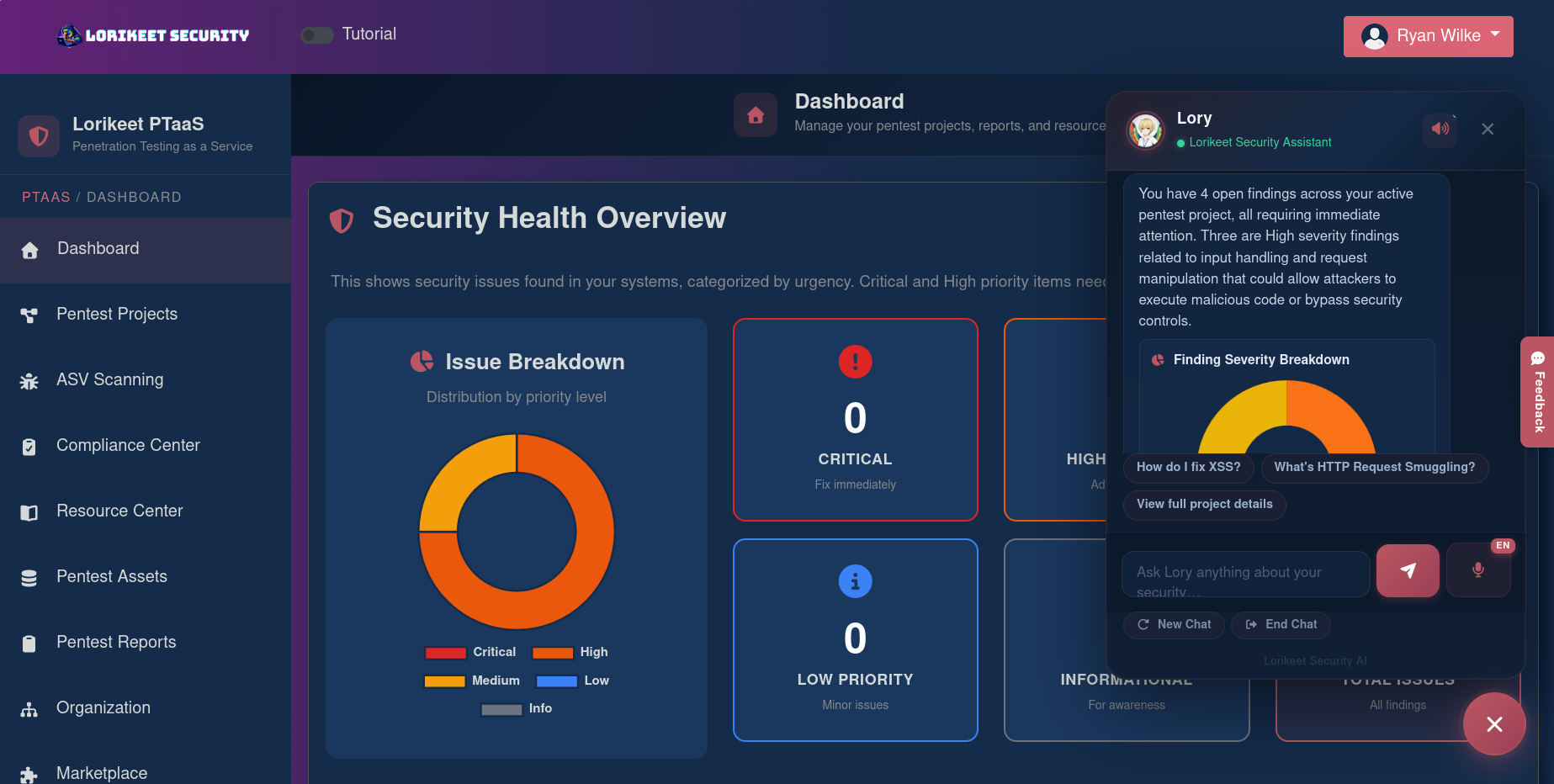
- Kick off Lory, the AI assistant: connect it to your engagement so the team can query nearly 2,000 vulnerability entries during triage and remediation.
Step 2: Core Features You Should Actually Use
- Real-time portal, not a dead PDF
- Watch tests run, triage in-channel, and assign owners. We’ve turned portal comments into instant Failure Post-Mortems, tagging services, model versions, and prompts.
- 100% manual penetration testing with free retesting
- No scanner dumps. We’ve seen testers chain prompt injection → SSRF via retrieval plugins → cloud metadata exfiltration. Retesting verifies your fixes before you declare victory.
- Continuous attack surface monitoring
- Practical example: auto-discovered a shadow API used by a background agent. We added auth, rate limits, and blocked risky model functions.
- Lory for guided remediation
- Ask: “Show all prompt-injection variants attempted against our doc loader and rank exploitability.” Lory summarizes attempts and links to dev- and auditor-friendly remediation steps.
- Compliance automation that isn’t busywork
- Map pentest outcomes to SOC 2 CCs or ISO controls. We’ve cut audit prep time by weeks by linking findings to policies, access reviews, and patch SLAs.
Step 3: Pro Tips for Artificial Intelligence Professionals
- Treat agents as hostile integrators
- Add tests for tool-use abuse, jailbreak transfers across tools, and data exfil via connectors. Use Lorikeet’s AI agent assessments to simulate real attacker behavior.
- Build Experiment Logs for defenses
- Track prompt template changes, guardrail policies, and model upgrades against Lorikeet findings. If a defense fails, capture it as a Failure Post-Mortem and harden the pipeline.
- Create Fine-Tuning Guides for secure behavior
- When testers find injection vectors, fine-tune or prompt-steer models with adversarial examples. Validate in Lorikeet’s free retest before rollout.
- Shift-left with “attack sprints”
- Before each release, run a focused engagement on new AI features (e.g., a new RAG source). Gate GA on remediation proof, not promises.
- Close the loop with training
- Use their awareness platform and phishing sims to drill engineers on secrets handling, token scope, and environment segregation—still the top causes of AI breaches.
Common Mistakes to Avoid
- Scoping too narrowly
- Don’t test just the web UI. Include plugins, retrieval sources, background agents, and cloud metadata endpoints.
- Treating it like a scanner
- Lorikeet is human-led. Share architecture diagrams, data flow maps, and prompt inventories so researchers can craft real exploits.
- Skipping retest
- Free retesting exists for a reason. We’ve seen “fixed” injection paths reappear via a new agent tool or deployment template.
How It Compares to Alternatives
- While Flowtriq excels at instant DDoS detection and auto-mitigation to protect uptime, Lorikeet Security is better suited for end-to-end offensive testing across apps, APIs, clouds, and AI agents.
- Ease of use: Flowtriq is plug-and-play for network resilience; Lorikeet requires scoped engagements but delivers deeper, manual findings with remediation coaching.
- Target audience: SRE/infra teams reach for Flowtriq to absorb traffic spikes; security, MLOps, and compliance teams choose Lorikeet to harden features, pass audits, and sustain secure velocity.
- Complementary strategy: Use Flowtriq to keep the lights on; use Lorikeet to ensure what’s behind the lights isn’t exploitable.
Conclusion: Is Lorikeet Security Right for You?
If your AI roadmap touches customer data, regulated sectors, or complex agent tooling, Lorikeet turns security from a last-minute scramble into a disciplined practice. We’ve found its real-time portal, manual research depth, AI-aware assessments, and compliance mapping translate experiments into production reality. For DDoS resilience alone, reach for Flowtriq. For discovering and fixing the vulnerabilities that quietly derail AI systems—and then proving they’re fixed—Lorikeet is the platform we’d ship with. Consider it your ongoing Breakthrough Story in shipping AI that fails safely, then improves fast.