Enhancing Sales Efficiency with Close.io for AI Professionals
What is Close.io?
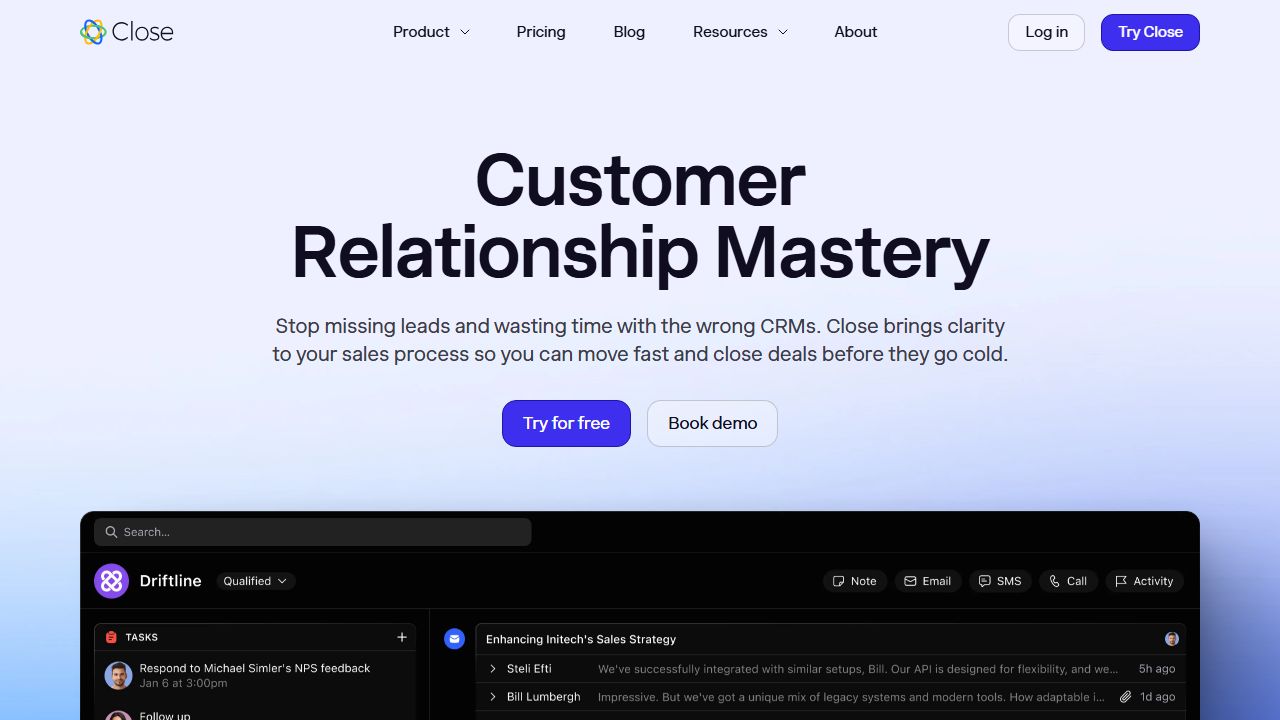
Close (formerly Close.io) is a sales-focused CRM built for high-velocity inside sales teams that live in email, phone, and SMS. It centralizes lead and contact management, multichannel outreach, and pipeline tracking in one fast interface, so reps spend more time in conversations and less in admin. For AI professionals, Close is a pragmatic hub: it exposes a clean API and webhooks for lead scoring, conversation intelligence, routing, and data ops—letting us plug models and automations directly into daily sales workflows. If you want a lightweight yet powerful CRM that your reps actually use, start at https://www.close.com.
Key Features and Capabilities
-
Multichannel communication built in. Close natively supports two-way email sync (Gmail, Microsoft, IMAP/SMTP), calling, and SMS from a single Inbox. Reps send bulk emails with templates and variables, schedule messages, and track opens/replies. SMS works alongside calls for quick follow-ups. Email Sequences automate persistent, human-sounding outreach while keeping responses in one thread.
-
Dialers for scale. Close’s Power Dialer accelerates outbound calling by moving reps through prioritized lists without manual dialing. For larger teams, the Predictive Dialer (on higher plans) dials multiple numbers per rep and connects only live answers—ideal for SDR teams. Call recording, voicemail drop, call coaching/whisper, and call transferring are baked in, which is rare for a CRM at this price point.
-
Lead, Contact, and Opportunity management that’s fast. The timeline view shows every touch—emails, calls, SMS, notes, tasks—in one place. Custom Fields let us track product-fit metadata (e.g., tech stack, ARR, ICP score). Smart Views (saved searches) are Close’s secret sauce: using filters and a powerful query builder, we create dynamic work queues like “Inbound hand-raisers with AI-fit score > 0.7” or “Stalled opps last touched > 7 days.”
-
Automation that plays nicely with data science. Sequences handle repeatable outreach; Bulk Actions update fields at scale; and native integrations plus Zapier cover common workflows. The Close REST API and webhooks open up deeper automation—push leads, update opportunities, listen to events (e.g., email replied, call ended), and feed outcomes back into your models. This is where AI teams can wire up lead scoring, LLM-assisted follow-ups, or conversation tagging loops without bending a monolithic marketing suite.
-
Reporting built for coaching and iteration. Pipeline, Activity, Funnel, and Leaderboard reports help us diagnose bottlenecks by stage, rep, or segment. Call metrics (connect rate, talk time), email performance, and sequence stats make it easy to A/B test outreach or compare cohorts. For custom BI, we export via the API to our warehouse.
Getting Started
- Create an account at https://www.close.com and start the free trial. Set your organization name, timezone, and invite the sales and ops teammates who will own setup.
- Connect email. Authenticate Gmail or Microsoft or add IMAP/SMTP. Choose sync direction and signature defaults; create shared templates with variables (e.g., {{contact.first_name}}, {{lead.company_name}}).
- Set up calling and SMS. Purchase local or toll-free numbers in the target regions, set recording defaults, voicemail drops, and call coaching permissions. Confirm compliance (TCPA/GDPR) and time windows.
- Model your pipeline. Configure statuses and opportunity stages to reflect your real funnel (e.g., New → Qualified → Demo → Evaluation → Closed Won/Lost). Add Custom Fields for ICP signals (industry, employee range, product usage flags).
- Import leads. Upload CSV or connect a source (Zapier, custom API). Map fields, de-duplicate on email/phone, and tag the import so you can build Smart Views.
- Build Smart Views. Create rep-ready queues like “Inbound – Needs First Call,” “Demo No-Show,” or “High Score (ML > 0.8).”
- Create Sequences. Draft 5–7 touch email sequences with variable text, add call tasks at key steps, and define send windows, spacing, and unsubscribe handling.
- Integrate and automate. Generate an API key, register webhooks for events you care about, and connect your enrichment, scoring, or data pipeline. Start with a minimal loop, then iterate.
Real-World Use Cases
-
AI-driven lead scoring and routing. Pipe product signals (trials, feature usage) into a model; write the score to a Close Custom Field via API; build Smart Views that float high-ICP, high-intent accounts to the top; auto-enroll qualified leads into Sequences; assign reps based on territory or vertical.
-
Conversation intelligence add-on. Export call recordings, transcribe with Whisper or a cloud ASR, summarize with an LLM, extract next steps and objections, and post them back to the lead as a Note. Tag calls with topics and sentiment, then analyze win/loss patterns in your warehouse.
-
Programmatic outbound for technical buyers. Combine enrichment (e.g., technographics) with Close templates to personalize at scale. Use the Power Dialer to quickly validate fit, then trigger follow-up SMS for fast scheduling. Feed outcomes (connects, replies, booked meetings) back into your model to refine targeting.
Pros and Cons
Advantages:
- Native multichannel (email, calling, SMS) in one fast UI; fewer tabs and tools to wrangle.
- Power Dialer and Predictive Dialer meaningfully increase connect rates for SDR teams.
- Smart Views and a robust search/query builder create actionable, dynamic work queues.
- Straightforward REST API and webhooks make it easy to plug in AI scoring and analytics.
Limitations:
- Not a full enterprise suite; complex, multi-department workflows may outgrow Close.
- Marketing automation is lighter than platforms focused on campaigns and nurture.
- Custom objects are limited; modeling very bespoke data structures can be challenging.
How It Compares to Alternatives
Compared to HubSpot, Close feels faster for reps and stronger on built-in calling, but it lags in deep marketing automation and CMS. Against Salesforce, Close wins on simplicity and speed-to-value, while Salesforce offers richer extensibility and enterprise governance. Versus Pipedrive, Close’s dialers and Inbox are more mature, though Pipedrive’s marketplace is broader. If you’re primarily doing outbound sequencing, Outreach and Apollo have advanced cadences and data, but Close gives you a true CRM plus strong multi-channel without stitching multiple tools.
Pricing and Value
Close offers tiered plans that scale with functionality and telephony. Expect core CRM, email sync, and basic reporting on entry tiers; advanced calling (Power/Predictive Dialer), call coaching, and deeper analytics on higher tiers. Predictive dialing and some telephony features are typically in top plans, and call minutes/phone numbers are billed separately. There’s a free trial, annual discounts, and straightforward per-seat pricing—solid value for lean teams optimizing for velocity.
Final Verdict
Close is an excellent fit for AI-first, high-velocity sales teams—startups, founder-led sales, and SDR-heavy orgs that need multichannel outreach, fast workflows, and clean API access. If your priority is enterprise-scale customization or heavy marketing automation, consider pairing or choosing an alternative. For most AI professionals building data-driven go-to-market loops, Close delivers the right blend of usability, automation hooks, and dialing power. Start a trial at https://www.close.com and wire your first ML-driven Smart View in a day.